Showing posts with label connect the unconnected. Show all posts

Thursday, April 23, 2020

Hyperscalers enter telco battlefront

We have, over the last few weeks, seen a flurry a announcements from hyperscalers investing in telco infrastructure and networks. Between Facebook's $5.7B investment in India's Jio Reliance, to Microsoft's acquisition of Affirmed Networks for $1.35B or even AWS' launch of Outpost and Google's Anthos ramp up.


Why are hyperscalers investing in telecom gear and why now?

Facebook had signalled its intent as far as 2016 when Mark Zuckerberg presented at mobile world congress his vision for the future of the company.


Beyond the obvious transition from picture and video sharing to virtual / augmented reality, tucked-in in the top right, are two innocuous words “telco infra”.
What Facebook realized is that basically anyone who has regular access to broadband will likely use a Facebook service. One way to increase the company’s growth is to invent / buy / promote more services, which is costly and uncertain. Another way is simply to connect more people.
With over 2,5 billion Facebook products users, the company still has some space to grow in this area, but the key limiting factor seems to be connectivity itself. The last billions of broadband unconnected are harder to attain because traditional telecom networks do not reach there. The last unconnected are mostly in rural area. Geographically disperse, with a lower income than their urban counterparts.
Looking at this problem from their perspective, Facebook reached a similar conclusion to the network operators operating in these markets. Traditional telco networks are too expensive to deploy and maintain to reach this population sustainably. The same tactics employed by operators to disaggregate and stimulate the infrastructure market can be refocused and better stimulated by Facebook.
This was the start of Facebook Connectivity, a specific line of business in the social media’s giant empire to change the cost structure of telco networks. Facebook connectivity has evolved to encompass a variety of efforts, ranging from the creation of TIP (an open forum to disaggregate and open telco networks), the co investment with Telefonica in a Joint Venture dedicated to connect the unconnected in latin america and this week, the announcement of its acquisition of 9.9% of Jio Reliance in India.


How about Microsoft, Google and others?

Google had, before the recent open source cloud platform Anthos dug their toes in telco water with project Fi and its fiber businesses.
Microsoft has been trying for he last 5 years to exploit the transition in telco networks from proprietary to IT. Even IBM's Redhat acquisition had a telco interest, as the giants also try to become a more prevalent vendor in the telco ecosystem.

So... why now?

Another powerful pivot point in Telecom is the emergence of 5G. As the latest telephony technology generation rolls out, telco networks are undeniably being re-architected and redesigned to look more like cloud networks. This creates an interesting set of risks and opportunities for incumbents and new entrants alike.
For operators, the main interest is to drastically reduce the cost of rolling out and maintaining complex telco networks by using powerful virtualization, SDN and automation techniques that have allowed hyperscalers to dominate cloud computing. These technologies, if applied correctly can transform the cost structure of network operators, particularly important at the outset of multi billion dollars investment in 5G infrastructure. The radical cost structure disruption comes from disaggregation of the network between hardware and software, the introduction of new vendors in the value chain who drive price pressure on incumbents and the widespread automation and cloud economics.
These opportunities bring also new risks. While they open up the supply chain with the introduction of new vendors, they also allow new actors to enter the value chain, either to substitute and dominate legacy vendors or create new control points (see the orchestrator wars I have been mentioning in previous posts). The additional risk is that the cost of entry into telco becomes lower for cloud hyperscalers as the technology to run telco networks transitions from proprietary closed ecosystem to open source, cloud environment.

The last pivot point is another telco technology that is very specifically aimed at creating a cloud environment in telco networks: Edge computing. It creates a cloud layer that can allow the provision, reservation and consumption of telco connectivity, together with cloud computing. As a greenfield environment, it is a natural entry point for cloud operators and new vendors alike to enter the telco ecosystem.

Facebook, Google, AWS, Microsoft and others seem to think that 5G and edge computing in particular will be more cloud than telco. Network operators try to resist this claim by building a 5G network that will be a fully integrated connectivity and computing experience, complementary to public clouds, but different enough to command a premium, a different value chain and operator control.

In which direction will the market move? This and more in my report and workshop Edge computing and Hybrid Clouds 2020.

Thursday, July 19, 2018

How Telefonica uses AI / ML to connect the unconnected


This presentation details how Telefonica has been using data science to systematically identify and locate the unconnected and to evolve its networks and operations to sustainably bring connectivity to the most parts of Latin America.

The project Internet para Todos is Telefonica's flagship program to connect the unconnected in LatAm. There are today more than 100 million people who live outside of reliable internet connectivity in the Telefonica footprint. The reasons are multiple, ranging from geography, population density and socio-economical conditions.

Fixed and mobile networks have historically been designed for maximum efficiency in dense, urban environments. Deploying these technologies in remote, low density, rural areas is possible but inefficient, which challenges the financial sustainability of the model.

To deliver internet in these environments in a sustainable manner, it is necessary to increase efficiency through systematic cost reduction, investment optimization and targeted deployments.

Systematic optimization necessitates continuous measurement of the financial, operational, technological and organizational data sets.

1.Finding the unconnected
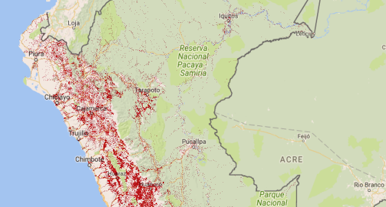
The first challenge the team had to tackle was to understand how many unconnected there are and where. The data set was scarce and incomplete, census was old and population had much mobility. In this case, the team used high definition satellite imagery at the scale of the country and used neural network models, coupled with census data as training. Implementing visual machine learning algorithms, the model literally counted each house and each settlement at the scale of the country. The model was then enriched with crossed reference coverage data from regulatory source, as well as Telefonica proprietary data set consisting of geolocalized data sessions and deployment maps. The result is a model with a visual representation, providing a map of the population dispersion, with superimposed coverage polygons, allowing to count and localize the unconnected populations with good accuracy (95% of the population with less than 3% false positive and less than 240 meters deviation in the location of antennas).
2. Optimizing transport
Transport networks are the most expensive part of deploying connectivity to remote areas. Optimizing transport route has a huge impact on the sustainability of a network. This is why the team selected this task as the next challenge to tackle.
The team started with adding road and infrastructure data to the model form public sources, and used graph generation to cluster population settlements. Graph analysis (shortest path, Steiner tree) yielded population density-optimized transport routes.

3. AI to optimize network operations
To connect very remote zones, optimizing operations and minimizing maintenance and upgrade is key to a sustainable operational model. This line of work is probably the most ambitious for the team. When it can take 3 hours by plane and 4 days by boat to reach some locations, being able to make sure you can detect, or better, predict if / when you need to perform maintenance on your infrastructure. Equally important is how your devise your routes so that you are as efficient as possible. In this case, the team built a neural network trained with historical failure analysis and fed with network metrics to provide a model capable of supervising the network health in an automated manner, with prediction of possible failure and optimized maintenance route.
I think that the type of data driven approach to complex problem solving demonstrated in this project is the key to network operators' sustainability in the future. 

It is not only a rural problem, it is necessary to increase efficiency and optimize deployment and operations to keep decreasing the costs.

Wednesday, May 17, 2017

How Telefonica and project Loon provided emergency connectivity relief in Peru

As I had teased in a previous post, one of the reasons I joined Telefonica is to explore how to change networks to make them more customer-centric. One of the teams I am supporting, in Telefonica Innovation, have been exploring how we can help provide affordable connectivity in the most remote parts of our footprint. Two thirds of the world is still not connected to the internet and Latin America has a large unserved population.
One of the technologies we have been evaluating is Project Loon.
Since 2014, Telefonica has been testing the technological capabilities of Project Loon. In 2014, we helped to bring internet connection for the first time to a rural school in Brazil as a test trial. Since 2016, we have been executing additional technical tests to use Project Loon’s technology as an extension to Telefonica’s mobile network to connect people in rural areas in Peru.
In the last few weeks, Peru has been hit by catastrophic floods and rainfall across many parts of the country. Hundreds of thousands of people have been affected and have seen their possessions, together with public infrastructure swept away. Telefonica´s terrestrial infrastructure suffered from failures and outages in some region and immediately, the teams started to repair the network.
 Telefónica and Project Loon brought basic Internet connectivity across more than 40,000 Km2, providing over 160 GB worth of data –enough to send and receive roughly 30 million WhatsApp messages, or 2 million emails. 
As part of this emergency, we agreed with Project Loon to temporarily expand the scope of the ongoing technical trials to provide emergency mobile connectivity to the affected areas while it continued to re-establish ground connectivity services.
For the past seven weeks, such collaboration led to connect tens of thousands of Telefonica customers on a daily basis across the most affected areas in the centre and northeast areas of Peru. Project Loon’s deployed infrastructure enabled Telefonica to deliver more than 160 GB of mobile data to its customers in areas outside Lima, Chimbote and Piura.
This is the first time that balloon-powered internet has connected tens of thousands of people. The joint trials in previous months had focused on integrating Project Loon's technology into Telefonica’s network to connect people to the internet in remote areas but this was the first deployment of the technology on this scale.
The company focused on bringing the best connectivity support in these emergency situations, especially in the most affected areas. It was a complex logistical challenge under extreme circumstances.
This effort was an exceptional demonstration of capacity to come together to help out people in times of need. Telefonica is committed to provide sustainable access to internet for all.
Stay tuned, I will provide updates over the coming months on how we are going to achieve that.

Wednesday, January 11, 2017

Innovation and transformation, micro segments and strands

When I first met the CEO of Telefonica Research and Development, David Del Val, he asked me what I thought of the direction the industry was taking. I have not been shy on this blog and other public forum about my opinion on operators' lack of innovation and transformation. My comments went something like that:
"I think that in a time very soon, I don´t know if it´s going to be in 3 years, 5 or 10, voice will be free, texts will be free, data will be free or as close to a monthly utility price as you can think. Already, countries are writing access to broadband in their citizens´ fundamental rights. Most operators are talking about innovation and new services, but let´s face it, they have had a pretty poor track record. MMS was to be the killer app for GPRS/EDGE, push to talk for 3G,video calling for HSPA, VoLTE for 4G... There is no shame in being an operator of a very good, solid, inexpensive connectivity service. Some companies are very successful doing that and there will be more in the future. But you don't need hundreds of thousands of people for that. If operators' ambition is to "monetize", "launch new services", "open new revenue streams", "innovate", they have to transform first. And it's gonna hurt."

At that point, I wasn't sure I had made the best first impression, but as you know now, that discussion ended up turning into a full time collaboration. 
The industry is undergoing changes that will accelerate and break companies that are not adaptable or capable of rethinking their approach. 
4G wasn’t designed as a video network capable of doing other things like browsing and voice; the telecoms industry designed 4G to be a multipurpose mobile broadband network, capable of carrying VoIP, browsing, messaging, … but really, it wasn’t so hard to see that video would be the dominant part of traffic and cost and growing. I don´t have a crystal ball but I had identified publicly the problem more than 7 years ago.

The industry’s failure to realize this has led us in a situation where we have not engaged video providers early enough to create a mutually profitable business model. The result is traffic is increasing dramatically across all networks, while revenues are stagnating or decreasing because video services are mostly encrypted. At the same time, our traditional revenues from voice and messaging are eroded by other providers. 

As the industry is gearing up towards 5G and we start swimming in massive MIMO, beam-forming, edge computing, millimeter wave, IoT, drone and autonomous vehicles, I think it is wise to understand what it will take to really deliver on these promises.

Agile, lean, smart, open, software-defined, self organizing, autoscalable, virtualized, deep learning, DevOps, orchestrated, open-source... my head hurts from all the trappings of 2016´s trendy telco hipster lingo. 
This is not going to get better in 2017.

The pressure to generate new revenues and to decrease costs drastically will dramatically increase on operators. There are opportunities to create new revenue streams (fintech, premium video, IoT…) or reduce costs (SDN, NFV, DevOps, Open source…) but they require initial investments that are unsure from a business case perspective because they are unproven. We are only starting to see operators who have made these investments over the last 3 years announcing results now. These investments are hard to make for any operator, because they are not following our traditional model. Operators for the last 20 years have been conditioned to work in standards to invent the future collectively and then buy technology solutions from large vendors. The key for that model was not innovation, it was sustainability, interoperability.
The internet has broken that model.
·      
I think that operators who want to be more than a bit pipe provider need to create unique experiences for consumers, enterprises, verticals and things. Unique experiences can only be generated from context (understanding the customer, his desire, intent, capacity, limitations...), adaptation (we don't need slices, we need strands) and control (end to end performance, QoS and QoE per strand). Micro segmentation has technical, but more importantly operational and organizational impacts.

Operators can't hope to control, adapt, contextualize and innovate if they can't control their network. Today, many have progressively vacated the field of engineering to be network administrators, writing RFPs to select vendors, or better, mandate integrators to select and deploy solutions. The result is networks that are very undifferentiated, where a potential "innovation" from one can be rolled out by another with a purchase order, where a change in a tariff, a new enterprise customer on-boarding, a new service takes years to deploy, hundreds of people, and millions of euros. 

Most operators can't launch a service if it has less than 10 million people addressable market, or it won't make the business case, right off the bat.

There are solutions, though, but they are tough medicine. You can't really rip the rewards of SDN or NFV if you don't control their implementation. It's useless to have a programmable network, if you can't program. Large integrators and vendors have made the effort to retool, hire and train. Operators must do the same unless they want to be MVNOs on their own networks. 

Innovation is trying. Projects can fail, technology evolves, but transformation is sustainable.